

1. What is a Small Language Model (SLM)?
A Small Language Model (SLM) is a compact and efficient AI system designed to understand and generate human-like text.
Unlike large models that need powerful servers, SLMs can run directly on regular devices like smartphones, laptops, and embedded systems.
 Small Language Models
Core Idea:
SLMs focus on specialized intelligence — they may not cover every topic, but they perform specific tasks very well. They are fast, cost-effective, and ideal when privacy and efficiency matter most.
Small Language Models
Core Idea:
SLMs focus on specialized intelligence — they may not cover every topic, but they perform specific tasks very well. They are fast, cost-effective, and ideal when privacy and efficiency matter most.
2. How SLMs Achieve High Performance
SLMs maintain strong performance using several techniques:
-
Focused Training Data: Trained on smaller, high-quality datasets for better accuracy in specific domains.
-
Knowledge Distillation: A smaller “student” model learns from a large “teacher” model to retain core capabilities.
-
Efficient Architecture: Modern designs activate only necessary parts of the model, improving speed and performance.
-
Fine-Tuning: Specialized training on domain-specific data such as healthcare or legal content.
3. Common Uses and Applications
-
Customer Support: Chatbots that answer questions and schedule appointments.
-
Text Analysis: Sentiment detection, content moderation, and feedback categorization.
-
Language Translation: Real-time, offline translation on mobile devices.
-
Healthcare: Summarizing notes and managing basic patient support.
-
IoT and Edge AI: Powering smart devices and automation without cloud dependency.
4. LLMs vs SLMs: Comparison
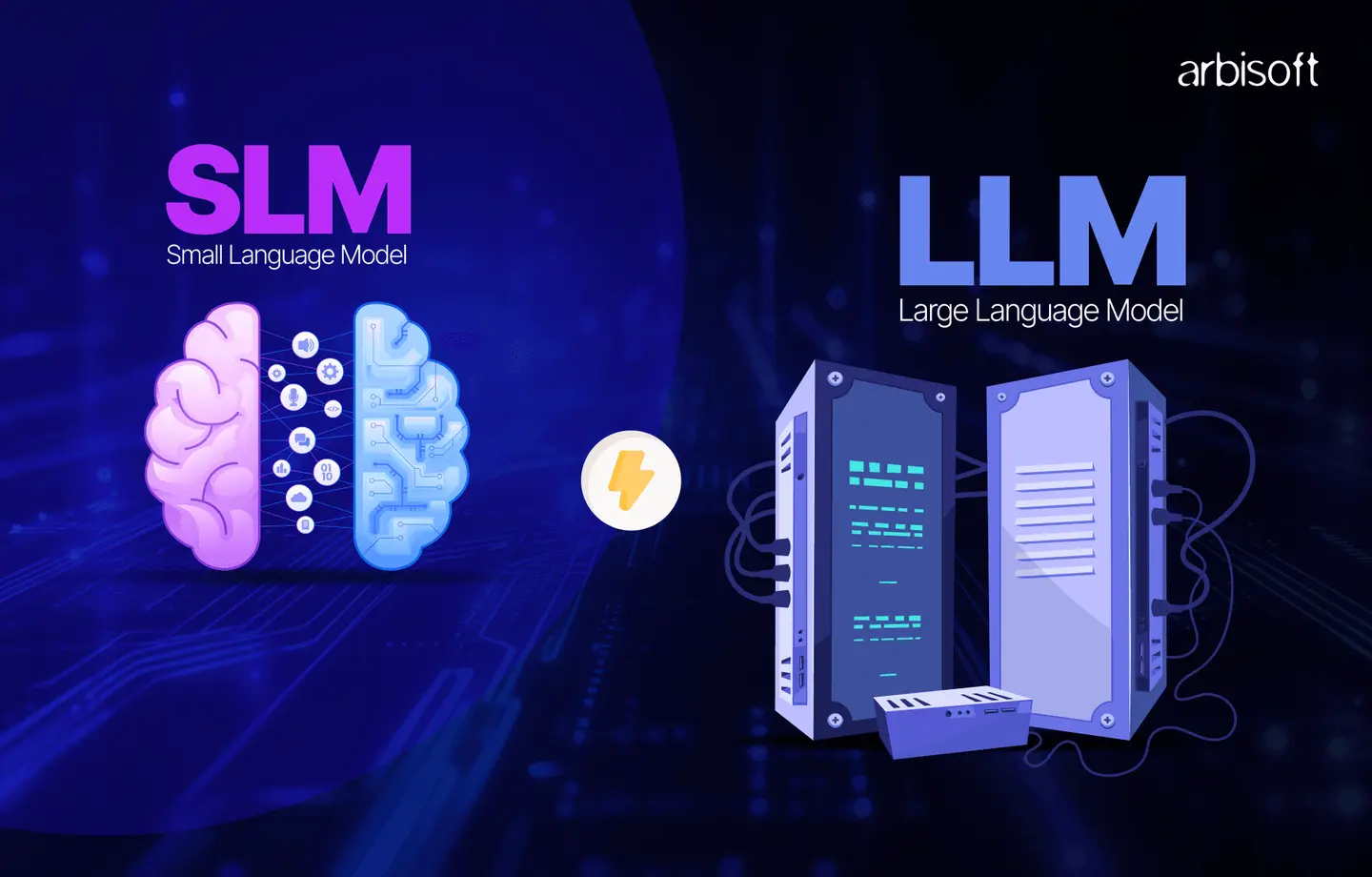
| Aspect | Large Language Models (LLMs) | Small Language Models (SLMs) |
|---|---|---|
| Parameter Count | Billions to trillions | Millions to a few billion |
| Architecture | Deep and complex | Simple and efficient |
| Training Data | Massive, general data | Smaller, curated data |
| Resource Needs | Requires cloud or GPUs | Runs on regular devices |
| Performance | Great for complex tasks | Best for specific domains |
| Speed | Slower responses | Instant, low-latency |
| Cost | Expensive | Affordable |
| Flexibility | Very adaptable | Limited to trained areas |
| Data Privacy | Cloud-based | Can run fully on-device |
| Customization | Hard to fine-tune | Easy and quick to adapt |
| Energy Use | High | Low and eco-friendly |
5. Key Benefits of SLMs
- Cost-Effective: Inexpensive to build and maintain.
- Fast: Delivers instant responses for real-time tasks.
- Private: Keeps data secure through local processing.
- Energy Efficient: Uses less power and supports sustainable AI.
- Customizable: Easy to adapt for specific industries or needs.
- Accessible: Makes AI available to smaller teams and organizations.
- Reliable: Works well even without internet access.
6. Limitations and Challenges
- Narrow expertise outside trained domains.
- Weaker in complex reasoning or multi-step logic.
- Limited general knowledge and creativity.
- Can reflect biases from training data.
- Not suitable for highly diverse or unpredictable tasks.
7. When to Choose an SLM
Choose an SLM when:
- You have a specific, well-defined task.
- Speed and low latency are critical.
- Privacy and on-device use are important.
- Budget and hardware are limited.
- You need offline or low-connectivity operation.